
Coil cleaning after a monsoon dust front
The monsoon window is fixed at 15 June to 30 September, and the dust fronts that come with it move as a wall at 30 to 60 mph. A single severe storm coats the outdoor coil with a fine layer that behaves like insulation on the surface whose entire job is rejecting heat. Capacity drops, head pressure rises, and the system eventually shuts itself down on its own high-pressure switch rather than on any fault a homeowner could see coming.
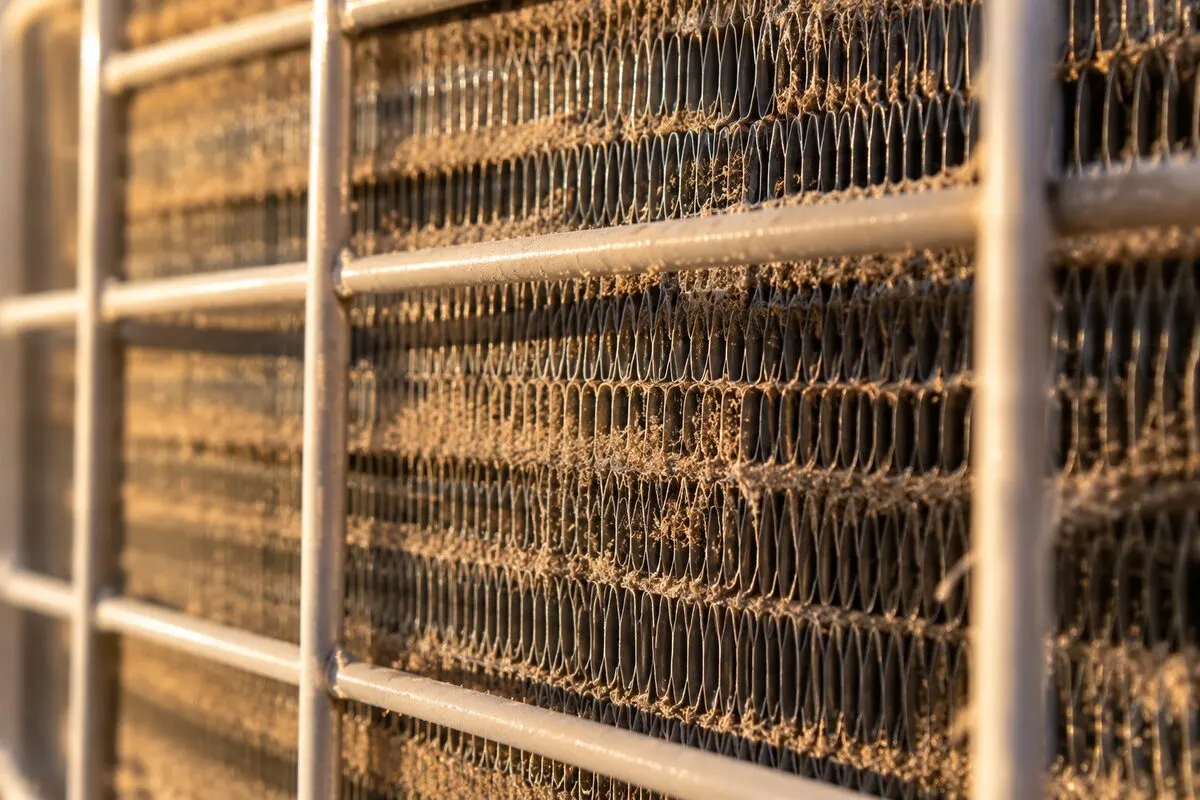
The right response is unglamorous: shut the system off during an active dust event so it is not drawing the storm through the filter, then rinse the coil afterwards with a hose from above and change the filter. Where a coil has been loading for several seasons, a proper cleaning means chemical cleaner and a technician, because the debris is no longer sitting on the surface: it is packed between fins that a hose cannot reach.
AC tune-up Mesa AZ: what a real visit measures
An AC maintenance Mesa AZ visit worth paying for produces numbers rather than a tick-list. These are the readings that should come back with the invoice.
- Superheat and subcooling, checked against the equipment's own design values
- Static pressure across the air handler, which decides whether the duct system can carry the output
- Temperature split across the indoor coil
- Capacitor microfarads compared with the rating printed on the can
- Amp draw on compressor, condenser fan and blower motor
- Contactor condition, condensate path, safety switch operation
Capacitor testing deserves singling out. A run capacitor that has drifted 15 percent below its rating will still start the compressor on a mild morning and fail to start it at 112 °F, which is why so many July no-cool calls are for a part that measured "fine" in a spring visit where nobody actually measured it. It is a few dollars in parts and the single most common cause of a summer outage in this climate.
Rooftop equipment needs the curb looked at too
On a packaged installation the cabinet sits on a curb, and the flashing around that curb is doing roofing work rather than mechanical work. Nobody sees it from the ground and it is not part of a standard tune-up unless the technician goes looking. On older Mesa and Sun Lakes houses this is where an inspection earns its keep: finding a deteriorating curb during a maintenance visit is a repair, finding it on the day of a change-out is a delay and a second mobilization.
Houses that stand empty need a different schedule
A large share of this coverage area is seasonal. Gold Canyon holds 18 percent of its housing for seasonal or occasional use, Apache Junction 12.8 percent, Sun Lakes 12.6 percent, Fountain Hills 11.9 percent, and Mesa 13,632 units in absolute terms. Those systems sit idle for months and are then asked for full output the week their owners return, which is precisely the pattern that finishes off a marginal capacitor, a corroded contactor or a stiff fan motor.
For a house on that cycle the useful AC maintenance Mesa AZ appointment is a startup check in the week of return rather than a tune-up in spring. It is also worth leaving the system running at a holding temperature through summer instead of switching it off, and having someone look in periodically. A failure discovered in week one is a repair, and a failure discovered in week eight is frequently more than that.
Maintenance coverage by city
- AC Repair in Mesa
- AC Repair in Gilbert
- AC Repair in Chandler
- AC Repair in San Tan Valley
- AC Repair in Queen Creek
- AC Repair in Apache Junction
- AC Repair in Fountain Hills
- AC Repair in Sun Lakes
- AC Repair in Gold Canyon
AC maintenance Mesa AZ: common questions
- When is the right time to book pre-season service?
- March and April for the cooling season, October for the heating side. Two things follow from booking early. The equipment gets checked before it is asked for full output on a 108-degree afternoon, which is when marginal parts declare themselves. And you are scheduling against a normal calendar rather than against a Valley-wide heat event, when every contractor in the metro is dispatching at capacity and the outer towns wait longest.
- Can I clean the condenser coil myself?
- The gentle version, yes. Shut off power at the disconnect, then rinse the outdoor coil with a garden hose directed downward from above, standing back rather than close in. Never use a pressure washer: the aluminum fins are thin enough to flatten under it, and once they are closed the airflow does not come back. Chemical coil cleaners, fin combing and anything involving opening the cabinet belong to a technician.
- How often do filters need changing in this climate?
- Monthly from mid-June through September, and every two to three months for the rest of the year. Houses backing onto open desert in Apache Junction, San Tan Valley or Gold Canyon load filters faster than houses inside a built-up grid. A loaded filter is not only an efficiency question: it drops pressure across the evaporator coil far enough to start freezing it, and a frozen coil presents exactly like a refrigerant fault.
- What should I be handed at the end of a maintenance visit?
- Numbers. Superheat and subcooling, static pressure on both sides of the air handler, temperature split across the indoor coil, capacitor microfarads against the rating stamped on it, and amp draw on the compressor and fan motors. Those readings are what let the next visit tell whether something is drifting. A visit that produces a tick-list and no measurements has not established anything about the system's condition.